
Most spreads hand you a map before you begin. Three cards here, ten cards there, every position labeled and waiting. The Pyramid Spread does something stranger and a little wonderful; it builds its own path as you go, and no two readings ever take the same route.
I came to this one through Mary K. Greer, who pulled it from a book by the French tarotist Jean-Claude Flornoy, who in turn learned it from a Parisian reader named Jean Assens. Flornoy called it the "cadillac of readings." After sitting with it for a while, I understand why.
What makes it different
This is a Major Arcana only spread. You set aside the pip and court cards and work with the 22 trumps alone, which gives the whole reading a big, archetypal, soul-level quality. You are not asking about Tuesday's emails. You are asking about the shape of a thing.
You also do not read every card you lay down. The spread reveals only the cards it wants you to see, sometimes two or three, sometimes nearly the whole deck. The rest stay face down and stay silent. That selectivity is the magic of it.
How to lay it out
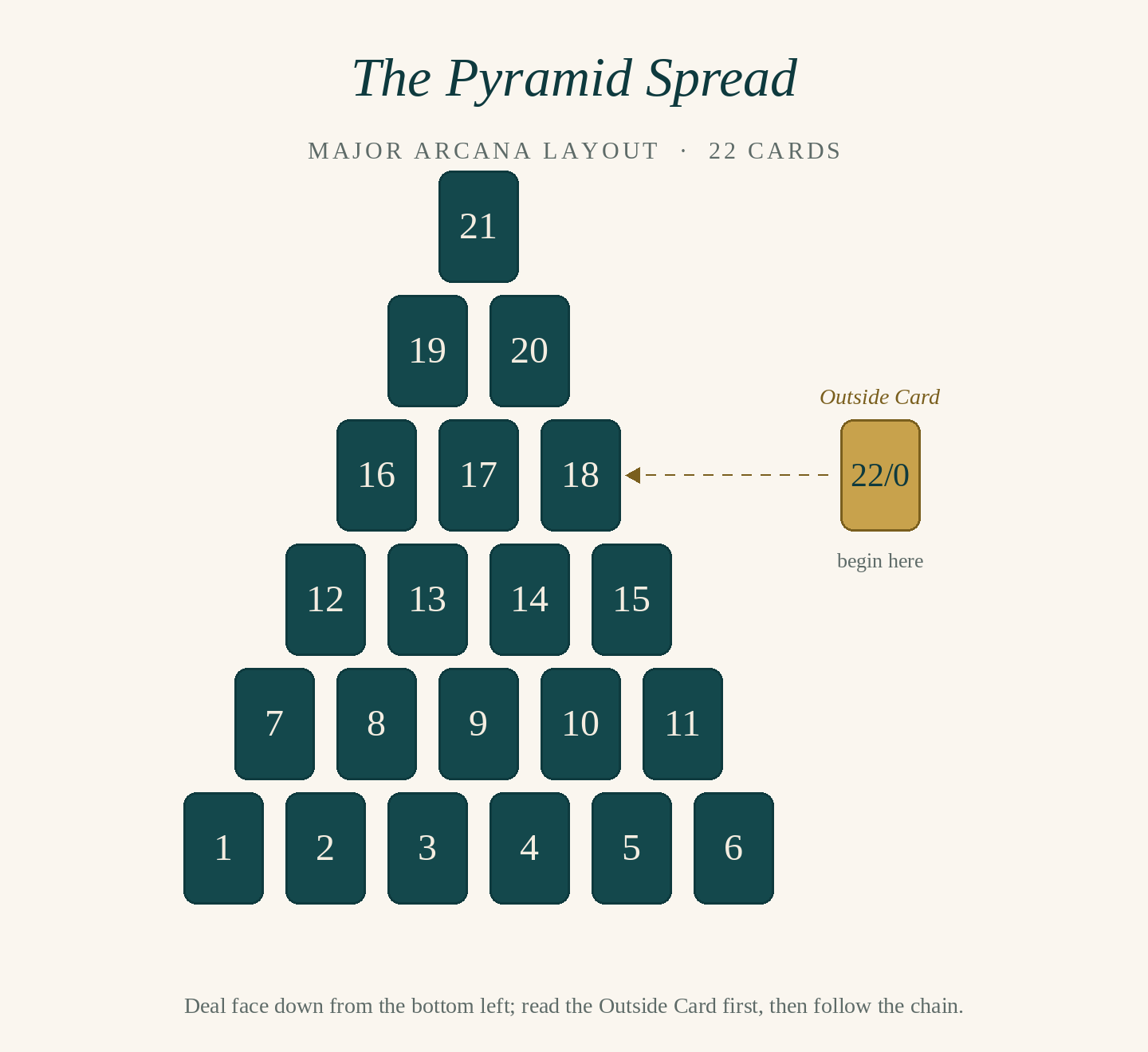
Shuffle all 22 Major Arcana while you hold your question. Then deal the cards face down into a pyramid, working from the bottom left up to the apex. The positions follow the numbers of the Majors in order:
Bottom row: positions 1 through 6
Next row up: 7 through 11
Then: 12 through 15
Then: 16 through 20
Apex: 21
That accounts for 21 cards. The 22nd card sits off to the right by itself. Flornoy called it the Outside Card and it is where the reading begins.
The chaining technique
Here is the part that makes people fall in love with this spread. Mary Greer calls it chaining.
Turn over the Outside Card first and read it against your question. Then look at its number. Whatever that number is, you go to that position in the pyramid and turn up the card living there.
Say your Outside Card is the Hermit, number 9. You go to position 9 and flip it. If you find the Lovers, number 6, sitting there, you read the Lovers, then travel to position 6 and turn up that card. You follow the thread from card to number to position, again and again, letting each card point you to the next.
You keep walking the chain until you reach the Fool. The Fool has no number, so when he appears, the reading stops. Wherever you land- that is where the story ends.
Every card you leave face down stays out of the reading entirely. You do not peek; you do not interpret them. They simply were not part of this particular path.
Greer's question-asking refinement
Flornoy described the layout but said little about how to read it, so Greer developed her own approach.
She treats each card as asking a question of the card that lands in its position; rather like reading a planet through the house it sits in. The earlier card poses the question and the next card answers it.
So if the Outside Card is Temperance reversed, you might turn one of its meanings into something open-ended: where is the imbalance here, or what is asking to be steadied. The next card in the chain responds. Sometimes that answer tells you the question was not quite right, and you adjust. That little back and forth keeps the reading alive and conversational instead of static.
A few practical notes
Reversals are optional. Use them if they are part of your practice; leave them out if they are not.
Greer noticed that positions 9, 17 and 21 seemed to carry extra weight, almost like anchor points of destiny, spirit and outcome. Watch what lands there.
This spread does not do well with yes or no questions. The Fool tends to show up as the Outside Card and end things before they start. Bring it open, reflective questions instead; the kind you actually want to sit with.
And a gentle word of honesty: because you are following your own intuition from card to card, this spread will happily show you your own assumptions right alongside your insight. Greer says as much about her own readings. That is not a flaw. Used on yourself, it becomes a quiet mirror for the things you already believe and had not noticed you believed.
When to reach for it
Pull out the Pyramid Spread when a question deserves depth and you have the time to follow where it leads. It shines for life-shape questions, turning points, inner work and any moment when the usual three-card pull feels too small for what you are carrying. It is also a beautiful way to finally use one of those gorgeous Major Arcana only decks that have been sitting on your shelf.
Give it a few tries before you judge it. The first reading feels unfamiliar; by the third, the chaining starts to feel less like a procedure and more like a conversation.
Working with the Majors and want a deck that feels like yours? Browse our tarot decks, wraps and altar pieces at Oracle Magick Supply, and let your cards walk their own path.
With thanks to Mary K. Greer, whose write-up introduced me to this spread, and to Jean-Claude Flornoy and Jean Assens before her.