
Beginner’s Guide to Dice Divination: How to Read the Dice
Most people meet dice at a board game. (Any Mahjong lovers here?!) They think of them as chance and nothing more. But long before dice rolled across felt board, they were rolled across temple floors for answers. If you found your life path number, you already know that numerology runs on single digits. Dice are a machine for making those digits. That is the whole secret. A die is not random when you hold a question inside it. It becomes an oracle you can carry in your pocket.
Here is where the practice comes from and exactly how to do it.
This is older than you think
Reading the dice belongs to a family of practices called cleromancy which means divination by casting lots. When the lots are dice, the older name for it is astragalomancy. The word comes from the Greek astragalos, meaning knucklebone, because the first dice were the ankle bones of sheep and goats, marked and thrown to answer a question.
The Greeks and Romans took it seriously. Marked bones have been found at temple sites. The practice was linked to Hermes, the messenger between worlds. Across the mountains in Tibet, an entire Buddhist system called Mo developed around casting a die to receive guidance, with the roller holding a question and reciting a mantra before the throw. Different cultures, same instinct. When you need an answer that your thinking mind cannot reach, you hand the question to something outside yourself and you read what comes back.
How to cast and read
You need two things. A die or a pair of dice and a real question.
For a full reading, use two dice. Hold your question, roll them, add the two numbers together and reduce that sum to a single digit the same way you would a birthday. A roll of six and five is eleven which means it is a master number so you leave it standing. A roll of six and six is twelve, it becomes one plus two, so three. Every roll lands you somewhere between one and nine, with the occasional eleven when the moment is charged.
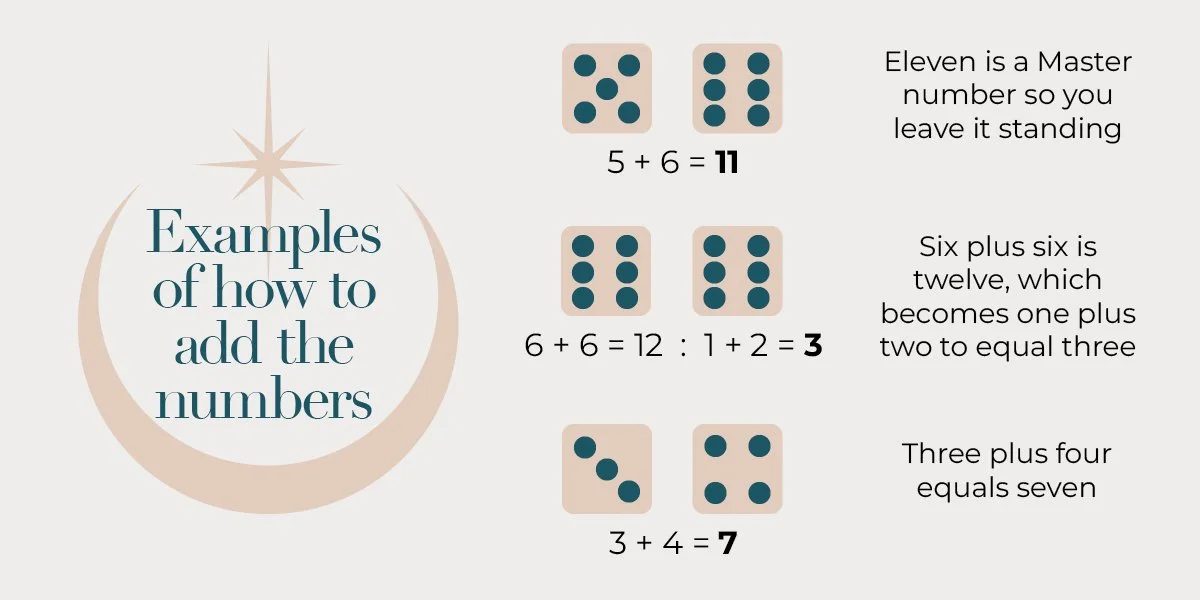
Then you read the number and here is your key.
One. Begin. The answer is action and it starts with you. Do not wait for permission.
Two. Wait or bring someone in. This is not yours to carry alone and patience is the move.
Three. Say it out loud. Express it. The answer wants creativity and honesty, not silence.
Four. Build it slowly. Do the unglamorous work because the foundation matters more than the speed.
Five. Change is coming or change is the answer. Loosen your grip and expect the unexpected.
Six. Tend to it. This touches home, care, or responsibility. Someone needs your attention and it might be you.
Seven. Go inward before you act. Study it, sit with it, and do not rush. Look under the surface.
Eight. You have more power here than you are using. This concerns money, ambition, or authority. Step up.
Nine. Let it go. This is an ending, a release, or a completion. Make peace and close the door.
Eleven. Trust what you already sense. The answer is intuition, not logic. Watch for signs over the next few days.
Ask the right kind of question
This is the part beginners get wrong and the old traditions were clear about it. Do not ask the dice to predict. Ask them to advise. There is a real difference between "will I get the job" and "what do I need to know about this job." The first traps you in waiting. The second gives you something to work with no matter how it lands.
Frame your question as a request for guidance. Then roll once. Do not roll again because you did not like the answer. The dice do not owe you a better result, they owe you an honest one.
A simple daily practice
You do not need a crisis to read the dice. The steadiest way to learn them is a morning practice and for this you only need a single die.
When you wake, before the phone and before the noise, take your die in your hand. Take one slow breath. Ask what you need to carry into this day. Roll once, look at the number, and read it as your theme. A four asks you to be steady and do the work in front of you. A five asks you to stay open and not over-plan. A seven asks you to protect some quiet for yourself.
Then go live the day with that number in your back pocket. By the time you have done this for a month, the numbers will feel like old friends and you will not need the key anymore.
Using the dice for meditation and self-reflection
Everything so far has pointed the dice outward, toward a question about your life. But the practice turns just as easily inward, and this is where it becomes personal. Here the die is not answering a question. It is choosing where you place your attention.
The thinking mind is a poor judge of what actually needs attention. Left to itself it will circle the drain with the same three worries and avoid the thing underneath. The die takes that choice out of your hands. You roll, you receive a number, and you agree to sit with whatever it brings, even if it is not the topic you would have picked.
Here is the meditation. Sit somewhere you will not be interrupted and take a die in your hand. Close your eyes for three slow breaths. Then ask a single inward question. Not "what will happen" but "what in me needs my attention right now." Open your eyes, roll once and read the number as a doorway rather than an answer. Close your eyes again and hold that theme for a few minutes. Do not solve it. Just let it be present and notice what rises.
Each number becomes a different room to sit in.
One. Where am I waiting for permission I do not actually need.
Two. Where am I keeping the peace by making myself small.
Three. What am I not saying out loud that wants to be said.
Four. What in my life feels unstable, and what would it take to steady it.
Five. Where have I been clinging when I need to loosen my grip.
Six. Who am I overgiving to, and who is that leaving depleted.
Seven. What answer am I looking for outside that already lives inside me.
Eight. Where am I holding back power I am afraid to use.
Nine. What am I still carrying that it is time to set down.
Eleven. What have I been sensing that I keep talking myself out of.
This is a natural journaling practice. Roll the die, write the number's question at the top of a blank page, and free-write for ten minutes without stopping to edit. You are not writing to sound good. You are writing to find out what you think when you stop performing.
A word of care. The inward roll can land on something tender. That is the point, but it is not a stress test. If a number opens something heavy, you are allowed to close the page, breathe, and come back another day. This is reflection, not endurance. The obsidian die is the one to reach for when you are ready to look at the harder rooms, and the amethyst when you want clarity without the sharp edges.
Start today
You do not need to know all nine meanings by heart. You do not need to be intuitive or trained or anything other than willing. Pick up a die, hold a real question and roll. Read the number, sit with it and notice over the coming days whether it was right. That noticing is how the practice grows roots.
The dice have been answering honest questions for a very long time. All they ask is that you bring them a real one.
Christine