
The Altar You Don’t Have to Put Away
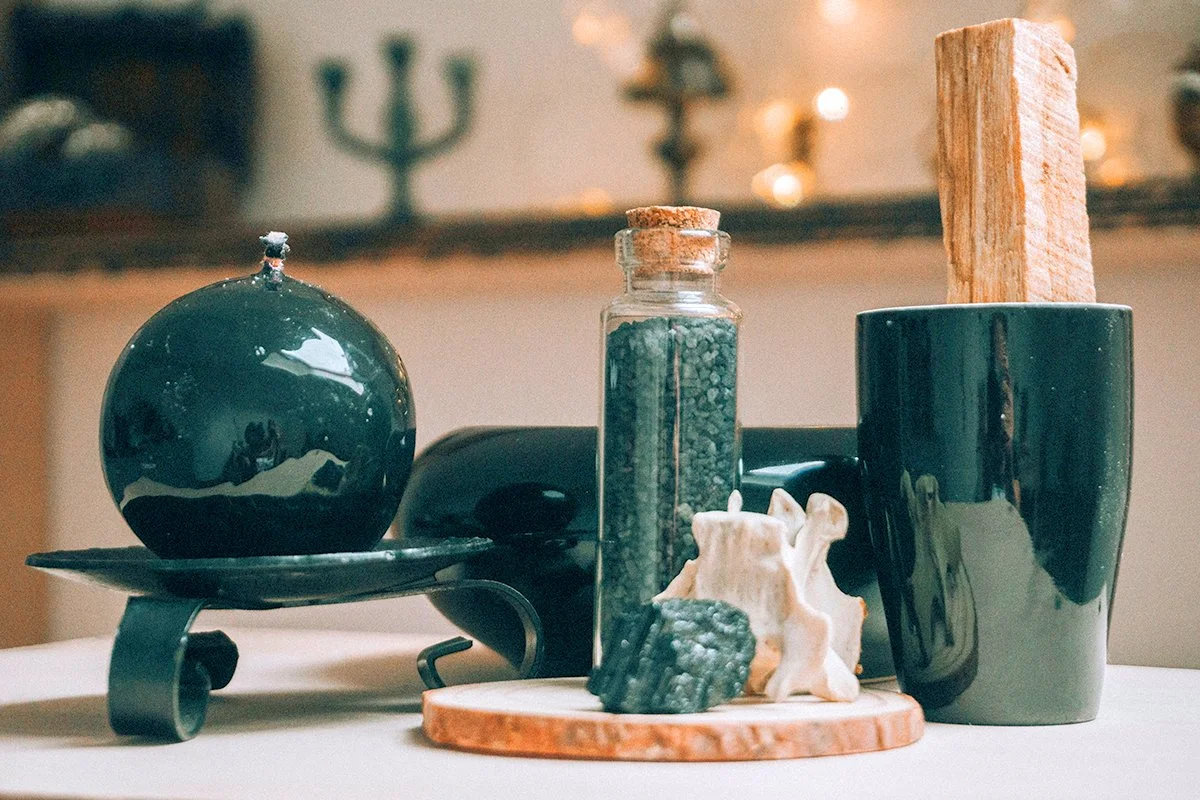
How to build a practice that lives in the open, even when your religious mother is on her way over
There is a reflex a lot of us know by heart. You find out someone is stopping by; maybe family, maybe the kind of family who would have feelings about a candle and a dish of stones; and your eyes go straight to the altar. Oh no! The cards! The crystal you have been working with all week! Before you have even decided to …. you are sweeping it into a drawer.
I want to talk about the version where you don't.
Not because you owe anyone a confrontation, and not because every altar has to be a statement. But a practice you keep hiding slowly starts to feel like something you should be ashamed of, and shame is a terrible foundation for spiritual work. An altar that lives in the open, in a room you actually use, tends to get used. The one in the drawer mostly stays in the drawer.
Here is how to build the first kind.
Hidden and discreet are not the same thing
This is the distinction that changes everything: Hiding your altar means putting it away so no one knows it exists. A discreet altar stays right where it is; it simply does not announce itself to a stranger walking through.
You can have both legibility and privacy at the same time. To you, the arrangement reads as a working altar with everything in its place. To your aunt, it reads as a pretty corner with a candle, some rocks and a healthy little plant. Nothing is concealed. Nothing demands an explanation either. That gap between what you see and what a casual guest sees is the whole magic trick. It lets your practice be honest without turning every visit into a debate you did not ask for.
Choose objects that do double duty
The fastest way to an altar that lives in the open is to build it from things that are quietly functional and quietly beautiful. Most ritual tools have an everyday twin.
A candle is a candle. A bowl of water for the element of water is just a lovely bowl. Crystals on a tray read as decor to anyone who is not looking for more; a chunk of rose quartz or a cluster of amethyst sits perfectly happily next to a stack of books. A pinch bowl of Himalayan salt looks like exactly what it is, salt, until you know what you are doing with it. Fresh flowers honor the season and the divine and also just brighten a table. Incense or a small censer reads as nice-smelling-home, not heresy.
A tray or a shallow dish is your best friend here. It gives the whole arrangement a frame, which makes it look intentional rather than scattered, and it lets you move the entire altar in one motion if you ever genuinely need to. Intentional is the word a guest's eye lands on. Intentional does not invite questions.
Where to put it
You do not need a dedicated room or even a dedicated table. You need a flat surface in a space that is part of your real life, because the point is integration, not a shrine you visit twice a year.
A console table by the entry works beautifully; it greets you every time you come home. A mantle is already designed to hold meaningful objects, so an altar there looks completely at home. A bookshelf gives you a built-in reason for crystals, candles and a deck to be sitting out. A windowsill catches light and moon both, and a sunny one keeps a plant honest. The kitchen counter near where you cook turns daily food into daily magic without anyone noticing the shift. A bedroom dresser keeps the work close to where you rest and dream.
Pick the spot you pass most often, not the most hidden one. The altar you walk by ten times a day is the one that becomes a practice instead of a decoration.
The open secret
Part of building an altar you never put away is getting comfortable with letting it be an open secret. You know what the arrangement is for. You do not need anyone else to know and you do not need anyone else to not know either. Both are fine. The freedom is in not needing their reaction to go a particular way.
So you stop curating the altar for an imagined critic. You place things because they belong, not because they will pass inspection. And a funny thing happens; the more matter-of-fact you are about it, the less anyone treats it as a thing to remark on. People take their cues from you. An altar you are visibly at peace with is an altar most guests simply walk past.
On your religious mother, specifically
You are allowed to have a bowl of stones and a candle on your own table. You do not owe your mother an explanation for it, and you also do not owe her a fight. Those are not your only two options. The third option is the calm one; you leave it exactly where it is, you do not narrate it and you let a candle be a candle.
If she asks, you get to decide how much to say in that moment, and you are allowed to say very little. "I like having a little beauty out where I can see it" is true and complete. You are not obligated to defend a cosmology over coffee. You are also not obligated to hide who you are in your own home so that she stays comfortable. The middle path between those is wider than it feels, and it is yours to walk at whatever pace you choose.
Choosing not to put the altar away is not an act of defiance toward her. It is an act of steadiness toward yourself.
Let it grow with you
An open altar is a living thing, so let it move. Swap the flowers when they fade; wilted offerings drag the whole feeling down. Rotate crystals as your focus shifts. Mark the turning of the seasons with a color or a small object, the way you would change a wreath, so the altar stays in rhythm with the year. A tarot or oracle card propped at the front, refreshed when you pull a new one, keeps a current intention in view.
The real shift here was never about furniture or placement. It is the moment you stop reaching for the drawer. Keep the altar out. Let it be seen, or not seen, on your terms. A practice you can live with in the open is a practice that gets to be part of your actual life, and that is the whole point of building one.
Oracle Magick Supply carries crystals, altar tools, ritual salt and tarot wraps for the altar you keep right where you can see it.