
Using Tarot for Yes or No Questions
Tarot Is a Mirror, Not a Yes-or-No Machine
People come to the cards wanting a verdict. Should I take the job? Is he the one? The hope is that tarot will hand back a clean yes or no so the decision stops being yours.
Mary K. Greer, who has spent decades teaching and writing about the cards, puts it about as plainly as possible: Asking a yes-or-no question is asking the tarot to be responsible of the decision instead of you. The cards are good at something else because they show you the shape of a situation, the motives moving under it, the parts you already sense. They reflect like a mirror and can not tell you to leave the house; it tells you what you look like before you decide.
So most of the time the better move is to retire the yes-or-no question and ask a question the cards can actually answer. Not "will I get the job" but "what is helping and what is hurting my chances." Not "should I stay" but "what am I not seeing about this relationship." The first kind closes the door and waits for a stranger to open it. The second kind keeps your hand on the handle.
But sometimes you really do want a yes or a no
There is a long tradition of tarot readers building spreads that force a binary answer, and one of the most charming lives in Mary Greer's archive of forgotten classics. She traced it back to a writer named Irys Vorel, in a February 1955 issue of Fate Magazine, under a title very much of its era, "How the Gypsies Use the Tarot." The framing is romanticized in the way mid-century occult writing tended to be; the spread underneath it is clever enough to have outlived the packaging.
Here is how it runs.
Write your question so that yes or no could honestly answer it. Keep it to one thing; a question like "should I marry Mike or Brad" is two questions, so split it. Don’t ask with options.
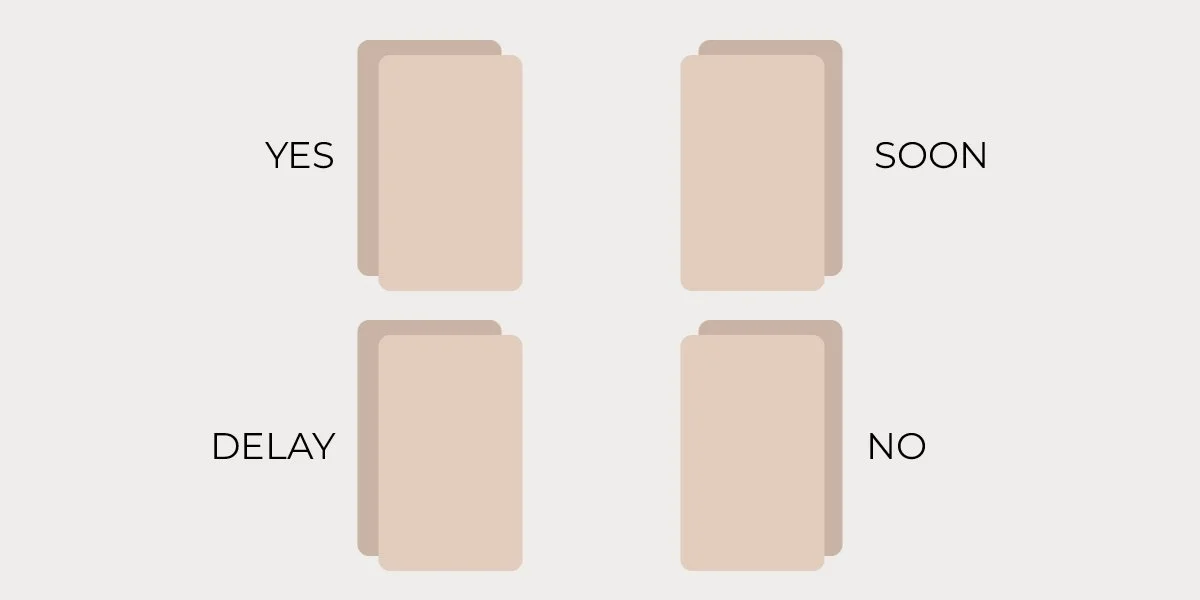
Take the Wheel of Fortune out of the deck and set it aside. It is the oracle now, not a card you read for meaning. Shuffle the remaining seventy-seven with the question in mind, draw seven, then mix those seven back together with the Wheel so you have eight cards and no idea where the Wheel sits.
Deal the eight into four corners, two cards to a corner.
Top left is Yes.
Top right is Soon.
Bottom left is Delay.
Bottom right is No.
Turn them over and find the Wheel. Whichever corner it landed in is your answer.
Yes means a quick and favorable resolution; the way is open. Soon means the yes is coming, so do not press too hard or rush it. Delay means the answer is not no, it is just slowed; there are obstacles to clear first. No means the conditions right now block a clean resolution and something has to shift; the same wish asked later, after circumstances change, may well come back yes.
Reading the room when the answer disappoints
If the Wheel lands on Delay or No, Vorel's method does something nice; it lets the rest of the spread explain the holdup. You look at all eight cards together, reversals ignored, and read by what is crowding the table.
Lots of Pentacles point to a money snag. A run of Swords means opposition, a fight or a disagreement in the way. Wands suggest travel, movement and change rather than a settled situation. A cluster of Cups leans the long-term outcome toward something kind and happy, strongest of all when the Ace of Cups is in the mix. Many Major Arcana say the matter is mostly out of your hands and destiny is doing the deciding. Many Court Cards say other people's wishes, not yours, will set how it lands.
It is a tidy little system and it works the way these things work, which is to say it gives you a frame to think inside.
Why I keep it at arm's length
Greer is honest that this is not her favorite kind of spread. It puts the outcome in the Wheel and in fate and in other people, and it quietly leaves you out of your own life. Her own demonstration of it is the best argument against it; she drew No to the question of whether to post the spread on her blog, then posted it anyway, because she is a person who gets to decide and the cards are not.
That is the whole point is: tarot is a mirror. Use the Wheel of Fortune oracle when you want a fast read and a bit of old magic. Use the open question, the what and the how and the why, when you actually want to move. The cards will meet you either way; they just do their best work when you stay responsible for the answer.
The Wheel of Fortune oracle is credited to Irys Vorel, Fate Magazine, February 1955, and was resurfaced by tarot scholar Mary K. Greer. An interactive version lives on the site if you want to try it without dealing out a physical deck.